
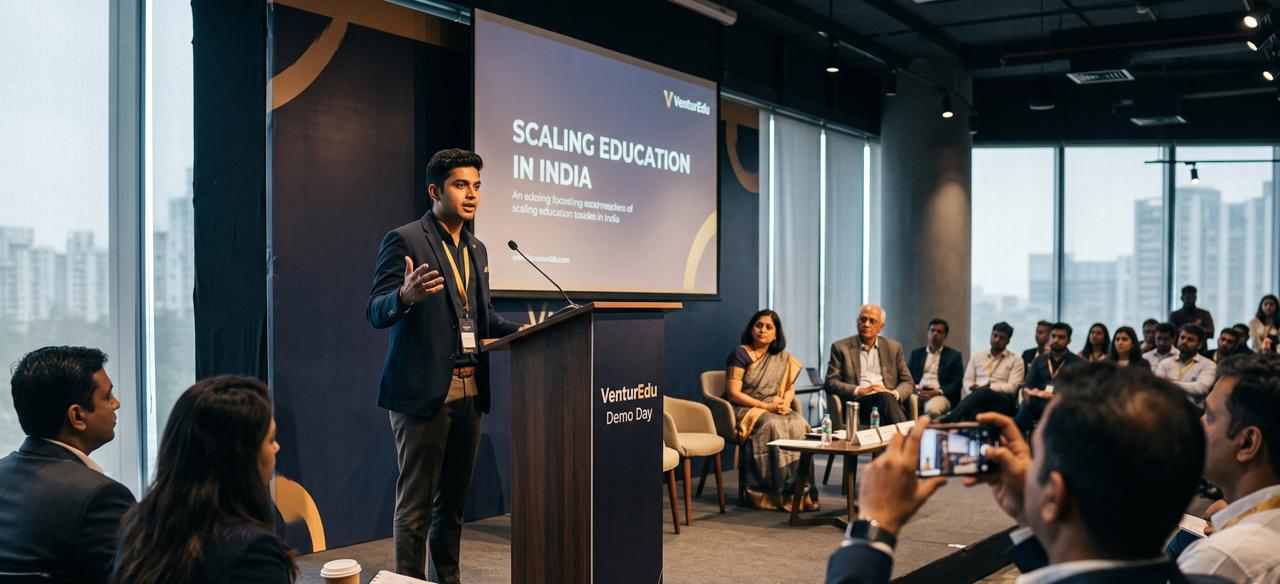
Quick answer: A startup accelerator is worth it for a first-time founder only if you already have a product and early traction. Accelerators run short, fixed cohorts that end in a demo day and usually take equity in exchange for a small cheque and intensive guidance. A model built for scaling, not for finding your business. If you are still at the idea stage with no formal business background, a longer, capital-committed venture school often fits better than a traditional accelerator.
Accelerators have become the default ambition for Indian founders, partly because the famous names and the demo-day photos make them look like the obvious next step. But the right answer depends entirely on your stage. This guide explains what accelerators actually do, when they help a first-time founder, when they hurt, and what to choose if you are not ready for one yet.
What is a startup accelerator?
A startup accelerator is a fixed-term, cohort-based program that takes an existing startup and compresses months of growth into weeks. A typical startup accelerator program runs three to six months, provides a small amount of capital, surrounds founders with mentors, and culminates in a demo day where they pitch to investors. In return, the accelerator usually takes a slice of equity.
The defining word is acceleration. The model assumes you already have something to speed up a working product, early users, or revenue. It is not designed to help you discover whether your idea works in the first place. That distinction is the single most important thing a first-time founder needs to understand before applying.
How is an accelerator different from an incubator?
The two terms get used interchangeably, but they serve opposite ends of the journey. An incubator nurtures an idea toward a first product over a longer, open-ended timeline and often takes little or no equity. An accelerator takes a product that already exists and pushes it toward fundraising on a tight clock, usually for equity.
Put simply: an incubator helps you find a business, an accelerator helps you scale one. Choosing the wrong one for your stage is the most common and most costly mistake first-time founders make.
Are startup accelerators worth it for first-time founders?
It depends on three honest questions about where you actually are.
Do you have traction yet?
If you have a live product and early users, an early stage startup accelerator can be genuinely transformative — it sharpens your metrics, opens an investor network, and forces fast iteration. If you only have an idea or a prototype with no users, you will struggle to keep pace with a cohort built around growth, and you may give up equity before your company is worth much.
Can you afford the equity?
Accelerator equity is cheap capital in a good outcome and expensive in a poor one. A first-time founder should treat the trade, a few percent of the company for a small cheque plus guidance, as a real financial decision, not a badge.
What do you actually need, speed or foundations?
Accelerators give speed. First-time founders frequently need foundations first: business fundamentals, a network, and time to validate. Speeding up something that is not yet built does not help.
If the answers point to "idea-stage, no business background, need foundations," a traditional accelerator is probably premature.
Key facts at a glance
Accelerator stage: product with early traction, not idea-stage.
Format: fixed cohort, 3–6 months, ends in a demo day.
Cost: usually equity for a small cheque plus mentorship.
Best for first-timers when: you already ship, have users, and need speed and investors.
Poor fit when: you have only an idea, no users, and no business foundation.
What should first-time founders look for in a startup accelerator in India?
If you do have traction and an accelerator fits, compare programs on four things rather than reputation alone.
Real capital, not just introductions. Ask how many founders actually get funded and whether the program deploys its own money. A startup accelerator India that only makes investor introductions is offering far less than one that backs graduates directly.
Mentor involvement. Distinguish active operators who build alongside you from guest speakers who appear once. The depth of weekly engagement determines how much you learn.
Sector relevance. A generalist program can dilute focus. Look for mentors and alumni who understand your specific market.
Life after demo day. Follow-on funding, network access, and continued support matter more than the cohort itself, because the hard part starts when the program ends.
What should you choose if you are not ready for an accelerator?
If you are a first-time founder with an idea but no product, no formal business education, or no network, the better path is a program designed for that exact gap. It should combine learning, building, and capital instead of assuming you already have all three.
VenturEdu, launched by the Gurugram-based venture platform Fibonacci X and founded by Kulmani Rana, is built for this stage. Rather than a short equity-for-cheque sprint, it runs a 14-month full-time residential PGP in Entrepreneurship where founders come with an idea and graduate with an investable venture.
Three things make it a better fit for a true beginner than a conventional accelerator. Its V-Unit model gives every idea a five-member mentor group consisting of a go-to-market specialist, a financial advisor, a brand advisor, a sector mentor with Series A+ experience, and an academic-industry partner. This ensures support is structured rather than occasional.
The second advantage is committed capital. A seed corpus of approximately ₹15 crore backs the program, with the top 30% of each cohort eligible for funding consideration. Founders also pitch at multiple investor demo days every month.
The third advantage is the residential and cross-border experience. The program combines a Gurugram campus with a six-week global immersion in Dubai or Singapore.
The trade-off is straightforward. A venture school requires a much greater time commitment than a three-month accelerator. However, for a first-time founder who needs strong foundations before scaling, that commitment is exactly what makes the difference.
The bottom line
Startup accelerators in India are worth it for the right founder at the right stage. If you already ship a product, have early users, and need to move fast toward funding, a strong accelerator can compress years into months. If you are starting from an idea with no business background, you will likely give up equity too early and struggle to keep pace; a capital-committed venture school is the better fit. Match the program to your stage, and the decision answers itself.
Frequently asked questions
Are startup accelerators worth it for first-time founders?
They are worth it if you already have a product with early traction and need speed and investor access. If you only have an idea and no business foundation, a traditional accelerator is usually premature, and a longer venture-building program fits better.
What is the difference between a startup accelerator and an incubator?
An accelerator takes an existing product through a short, fixed cohort toward fundraising and usually takes equity. An incubator nurtures an idea toward a first product over a longer timeline and often takes little or no equity.
Do startup accelerators in India take equity?
Most private accelerators take equity in exchange for a small cheque and mentorship. Always confirm the exact terms, including equity percentage, cheque size, and what you receive, before applying.
How long does a startup accelerator program last?
Most accelerator programs run three to six months and end in a demo day. Residential venture schools like VenturEdu's PGP run far longer, at 14 months, because they combine education and building, not just acceleration.
What is a good alternative to an accelerator for a complete beginner?
A residential venture school is a strong alternative for idea-stage founders. VenturEdu, backed by Fibonacci X, runs a 14-month PGP in Entrepreneurship that combines structured learning, hands-on building, mentorship, and a committed ₹15 crore seed corpus.
.png)