The main MBA alternatives for entrepreneurs in India are a full-time venture school, an accelerator or venture studio, a job inside an early-stage startup, and bootstrapping while you learn through free or low-cost founder programmes. An MBA with an entrepreneurship focus is the fifth route. It is the most expensive, at roughly ₹27.5 lakh to ₹40.5 lakh at top schools as of November 2026, but it is also the only one that leaves you with a degree and a placement fallback. The right choice depends less on prestige and more on three things: whether you already have an idea, how much runway you have, and whether you need capital or skills first.
Is an MBA necessary to start a business?
No. India sets no educational requirement for registering or running a company, and the record of its most successful founders points away from business degrees. A 2024 analysis by YNOS Venture Engine, an IIT Madras incubated platform, looked at 206 founders of Indian unicorns and found that over 67% came from engineering backgrounds, while non-engineers, including business, commerce and economics graduates, made up just 9%.
That does not make the MBA useless for founders. A good programme teaches finance, strategy and negotiation in a structured way, puts you in a room with future customers, co-founders and investors, and gives you a credential that protects your career if the venture fails. For someone switching from engineering or law into business, those two years can close real gaps.
The problem is fit. A general MBA is designed to place graduates into jobs, so most of the coursework, the recruiting calendar and the peer pressure pull you towards employment, not founding. If your goal is to build a company, the useful question is not whether you need an MBA but which route gets you to a working venture with the least waste of money and time. The five routes below answer that question differently.
How do the 5 routes compare?
Each route trades cash, time and equity in a different mix. Figures are as of November 2026.
Route | Cash cost | Time | What you leave with | Access to capital | Best for
|
|---|---|---|---|---|---|
MBA, entrepreneurship focus | ₹27.5 lakh (IIM Ahmedabad, 2025-27) to about ₹40.5 lakh (ISB, incl. GST) | 1 to 2 years | Degree, alumni network, placement fallback | Indirect, through campus incubators | People who want a safety net |
Venture school or founder programme | Varies; full-time residential fees can match an MBA | Full-time, varies by school | Your own venture, founder skills, mentors | Built in at some schools | First-time founders who want structure |
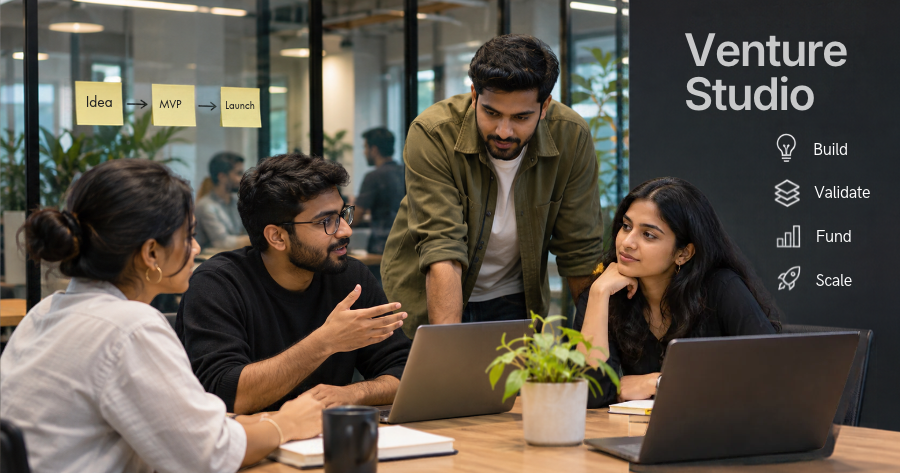
Accelerator or venture studio | No fee, paid in equity | Weeks to months | A funded company, if selected | Direct, often in crores | Operators with a team or a track record |
Early-stage startup job | None, you earn a salary | 1 to 3 years | Experience, network, ESOPs | None directly | Graduates without an idea or savings |
Bootstrap with short programmes | Free to low, plus your savings | Open-ended | Your own venture, full ownership | Small grants, up to ₹20 lakh | Founders with an idea and runway |
The sections below explain what each route involves in practice.
What does an MBA with an entrepreneurship focus give a founder?
An MBA works best for founders when you use the school's startup infrastructure rather than just its classes. The cost is high: IIM Ahmedabad's two-year PGP cost ₹27.5 lakh for the 2025-27 batch, the latest confirmed figure, while ISB's one-year PGP for the 2027-28 batch totals ₹40,46,520 including GST with shared accommodation, plus an estimated ₹2.25 lakh for books, a laptop, meals and other costs. Add the salary you give up while studying.
Where the value sits
Campus incubators: IIM Bangalore's NSRCEL and ISB's DLabs run pre-incubation and accelerator programmes. DLabs' ISPROUTE, a 10-week programme that takes an idea towards proof of concept, opened its 2026 intake to ISB's PGP Class of 2027.
Placement flexibility: some schools now let you defer jobs. In June 2026, IIM Calcutta announced that MBA students can spend a year building a startup and then return for campus placements the following year.
Peer network: your batch is a pool of potential co-founders, first customers and future angel investors.
The catch is that an MBA rewards you for staying employable, and an education loan can make a risky first venture harder to justify. If you are weighing a founder-focused postgraduate programme directly against this route, our PGP in Entrepreneurship vs MBA comparison covers that choice in detail. Founder-focused programmes are the second route.
What is a venture school or founder programme?
A venture school, sometimes called a founder programme, is built around one outcome: you leave with a company, not a job offer. The coursework follows the stages of a startup, such as validation, building a first product, selling and raising money, and you apply each stage to your own venture while you learn it.
Full-time residential fees can be close to a top MBA's, so judge a programme by whether it ties capital to performance. VenturEdu's full-time residential PGP in Entrepreneurship in Gurugram is one example. Its fee is ₹25,00,000 plus GST, with scholarships of up to 50% after assessment, founders build their own ventures with 50+ mentors, and the top 30% of a cohort with an investable pitch receive an assured investment offer from its in-house fund.
Before you apply to any founder programme, check four things in writing: whether the venture and its intellectual property stay fully yours, whether the school takes equity, what share of past students actually raised money, and whether the mentors are active operators. A school that answers all four clearly is offering something an MBA does not. If you would rather skip tuition and pay with equity, the third route works that way.
Should you join an accelerator or a venture studio instead?
Accelerators and venture studios charge no fee. They take a share of your company in exchange for capital, mentoring and investor access, which makes them the fastest way to a funded startup and the most selective. Current terms show the range:
Y Combinator: invests $500,000 in total, with $125,000 for a fixed 7% and $375,000 on an uncapped SAFE that takes the best terms of later SAFEs.
Antler India: its February 2026 AI Residency offered a potential ₹4 crore investment for 11% equity, plus a one-time ₹2 lakh grant for founders' expenses, with investment decisions in about three weeks.
The Foundery: a 90-day residential venture studio launched by Nikhil Kamath and Kishore Biyani, where selected founders keep up to 25% of the company and ventures that hit milestones can receive up to ₹4 crore in seed funding.
The difference between the two models is ownership. An accelerator backs a company you started, so you keep most of it. A studio usually brings the idea and the team and keeps a much larger share. Both select for evidence of execution, so a fresh graduate with no shipped product rarely gets in. Our guide to startup accelerators in India compares the main programmes and their terms. If you are not ready to be selected yet, the fourth route builds that track record while paying you.
Is working at an early-stage startup a good MBA alternative?
For many would-be founders, it is the most underrated option. Joining a seed or Series A company, especially in a founder's office or generalist role, puts you next to the people doing what you want to do. You see hiring, fundraising, pricing and firefighting up close, and someone else pays for your education.
What you gain
Paid learning: you earn a salary instead of paying fees, and some roles add ESOPs.
Real scars: you watch decisions play out with real money, which no case study replicates.
Future network: colleagues become co-founders, early hires and introductions to investors.
What you give up
No capital: nobody funds your idea because you worked at a startup.
Drift risk: a comfortable role can quietly delay your own venture for years.
Set a deadline and a savings target before you join. When you are ready to leave, our guide on when to quit your job to start a startup lists the signals worth waiting for. For people who already have an idea and some savings, the fifth route skips the waiting.
Can you bootstrap and learn through short programmes?
Yes, and in India the free support available to an early founder is better than most people assume. You build your venture on your own savings, keep full ownership, and plug skill gaps with short, low-cost programmes that often come with small grants.
NSRCEL Launchpad: IIM Bangalore's five-month pre-incubation programme for founders at idea, prototype or MVP stage charges no fee, and its top two incubatees can receive grants of up to ₹5 lakh. Applications for the 2026 cohort have closed.
NSRCEL Campus Founders: students and those who graduated less than a year ago can apply with a working prototype, and the few ventures that complete its phases can receive milestone-based grants of up to ₹5 lakh.
YC Startup School: Y Combinator's free resources for early and future founders.
Seed Fund Scheme: under the Startup India Seed Fund Scheme, DPIIT-recognised startups incorporated within the last two years can get up to ₹20 lakh in grants for proof of concept and up to ₹50 lakh in debt or convertible instruments, routed through approved incubators. The scheme's original funding window ran to 2024-25, so confirm with an incubator that it is still accepting applications.
The weakness of this route is isolation. Without a cohort or a mentor holding you to deadlines, it is easy to spend months building something nobody pays for. Our list of the best startup courses in India can help you add structure without the cost of a full degree. With all five routes laid out, the remaining step is matching one to your situation.
Which route should you choose: MBA or startup?
Start with your constraints, not the brand of the programme. Most people fit one of these profiles:
No idea yet: work at an early-stage startup, or apply to a studio if you have a strong operating record.
Idea, little structure: a venture school gives you a deadline, mentors and a path to capital while you build.
Idea and team: apply to accelerators and stack free grants instead of paying tuition.
Need a fallback: an MBA makes sense if a corporate career is a genuine plan B, ideally at a school with an active incubator.
Idea and savings: bootstrap, test demand cheaply and apply to programmes once you have early traction.
Whichever route you pick, test your idea before you commit lakhs of rupees or years of time to it. Our guide on how to validate a startup idea in India shows how to do that in weeks with little money. Customers you have spoken to will teach you more than any programme can, and they make every route on this list work better.
Frequently asked questions
Can I become an entrepreneur without an MBA?
Yes. You need no degree to register a company in India, and most Indian unicorn founders studied engineering rather than business. Investors back traction, insight into a market and the ability to execute, all of which you can build without a business degree.
Is an MBA worth it for starting a business in India?
It can be, if you plan to use the school's incubator, network and placement fallback. It is hard to justify purely for the coursework, because top programmes cost about ₹27.5 lakh to ₹40.5 lakh and keep you out of the workforce for one to two years.
Should I do an MBA first or start a startup first?
If you have a validated idea and enough savings for 12 to 18 months, starting first usually teaches you more, and you can still apply to an MBA later with a stronger profile. If you have neither an idea nor work experience, a few years in a job or a startup role is often a better first step than either.
Which MBA colleges in India are best for entrepreneurship?
Look for schools with an active incubator and flexible placement rules rather than rankings alone. IIM Bangalore's NSRCEL, ISB's DLabs and IIM Calcutta's option to defer placements by a year are examples of the support that matters most to founders.
Can I start a business while doing an MBA?
Yes, and many students do. Campus incubators, business plan competitions and classmates make it a good place to test an idea. The hard part is time, since a full-time MBA leaves little room for building, so many students validate during the programme and commit after graduating.
Do investors in India prefer founders with an MBA?
Not as a rule. Early-stage investors look for evidence that you understand the problem and can execute, such as customers, revenue or a working product. An MBA can help with introductions and credibility, but it rarely decides an investment on its own.
What is the cheapest way to learn entrepreneurship in India?
Combine free programmes with a real project. NSRCEL Launchpad charges no fee, YC Startup School offers free resources, and government schemes such as the Startup India Seed Fund provide grants through incubators. Building something small while you learn is cheaper than any course.
Is a founder's office role good preparation for starting a company?
Usually, yes. Working directly with a founder exposes you to fundraising, hiring and strategy decisions while you earn a salary. The risk is staying too long, so set a clear exit date and savings goal before you take the role.