.png)
A pitch deck for investors in India has one job: earn the next meeting. An Indian angel or seed fund sees thousands of decks a year and spends under three minutes on a cold one, so every slide has to justify its place. This guide walks the standard slide arc in order, with the India-specific expectations that most US templates miss: bottom-up market sizing, rupee-denominated unit economics, and the governance signals that clean, compliant startups get credit for.
Get the structure right and the deck does what it is meant to do: filter you in, not out.
How many slides should a pitch deck have?
Keep an early-stage pitch deck to 12 to 15 slides. This isn't arbitrary. Startup India's own pitch guidelines recommend an initial presentation of no more than 12 to 15 slides, and funded-deck data lands in the same range: the decks investors actually read through to the end average around 12 pages.
Slide count also flexes with how the deck is used. A cold-email version runs 10 to 12 slides, a live presentation deck 12 to 15, and a later-stage diligence deck can grow an appendix to 15 to 20. Across all of them the arc stays the same. What grows is the appendix, not the story. Send a PDF, never an editable file, and keep it lean.
The reason the order matters is that each slide answers the logical question the previous one raises. Investors read a deck against a mental checklist, and the standard sequence matches that checklist. Here is the arc.
The 12 slides an Indian investor deck needs
1. Title
One line that says exactly what you do, plus your logo, and the raise in a phrase. Not a tagline puzzle. The strongest one-liners read like the email that got you the meeting: category, traction, ask. For example, "B2B invoicing SaaS, ₹3.2L MRR growing 18% month on month, raising ₹6 crore seed." Add your name, city, and contact details so the deck works standalone.
2. Problem
Name the real, specific pain your target customer feels, in their words. Indian investors are wary of invented problems dressed up with big numbers. Ground it: who has this problem, how often, and what it costs them today. One sharp problem beats three vague ones.
3. Solution
Show how you solve it, simply. This is not the place for a feature dump. State the core insight and what your product actually does, ideally with a single screenshot or a one-line before-and-after. The test is whether a non-expert understands the value in ten seconds.
4. Market size
This is the slide that separates credible Indian decks from the rest. Build your market bottom-up, not top-down. The fastest way to lose a room is the "1% of 140 crore people" maths. Instead, size it from the ground: number of realistic customers, multiplied by what they actually pay, in rupees.
Localise the number using Indian sources investors trust: RBI data, IBEF sector reports, and category-level data from Venture Intelligence or similar. Investors evaluating a ₹10 to 50 crore seed round want to see the India opportunity sized independently before any global projection. Present TAM, SAM, and SOM, but spend your credibility on the SOM, the slice you can realistically win.
5. Product
Show the product working. A short flow of two or three screenshots, a simple diagram, or a demo link. For pre-product startups, a clickable prototype or mockup is fine. The goal is to make the solution concrete and prove you have built, or can build, the thing.
6. Traction
For early-stage decks, this is often the slide investors jump to first, and the bar is evidence quality, not size. A smaller number with strong retention beats a bigger number that is flat. ₹1.5 lakh MRR with month-six retention above 80% is more fundable than ₹4 lakh MRR with churning cohorts.
Show a cohort or retention curve, revenue trend, and any signal of real demand: paying customers, pilot results, growth rate, waitlist, partnerships. Avoid vanity metrics. In India especially, three traps kill credibility here: counting GMV as revenue, annualising one good month, and leaning on downloads instead of usage. Show numbers that will survive diligence, because a fund's analyst will rebuild them from your data room anyway.
7. Business model
How you make money, in plain terms. Revenue streams, pricing, and unit economics. Tie it to real figures rather than "we will monetise later." The metric relationship investors look for is LTV comfortably exceeding CAC, with a payback period that makes sense for your category. Present unit economics in the Indian context: what a customer costs to acquire here, and what they are worth over time. If unit economics are unfamiliar territory, the best startup courses in India cover the financial fundamentals every founder needs before a raise.
8. Competition
Show you know the landscape, honestly. A simple two-axis positioning map or a feature matrix comparing you to real alternatives, including the "do nothing" option and any incumbent workarounds. Claiming you have no competition reads as naivety. What investors want is a clear, defensible reason you win: a wedge, an unfair advantage, or a structural edge.
9. Go-to-market
How you will reach customers and grow. Channels, the motion (self-serve, sales-led, distribution partners), and early evidence of what is working. For Indian markets, be concrete about the realities of your channel, whether that is regional expansion, vernacular reach, offline-to-online, or a specific distribution partnership. Show CAC by channel if you have it, and your organic-versus-paid mix.
10. Team
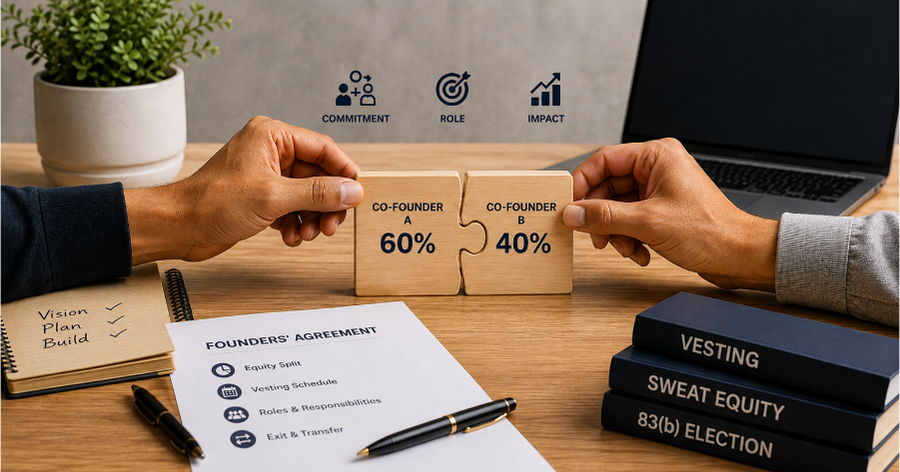
Why you, and why now. Founders' names, roles, and the specific experience that makes you the right people to build this. Mention shareholding or co-founder split at a high level. Indian investors are explicit about this: a part-time founding team is a common reason decks get passed over. Show full commitment and complementary skills, and name key advisors if they add real weight. If you are still assembling your team and traction, joining a startup accelerator in India can help you build both before you raise.
11. Financials
A realistic three-to-five-year projection in rupees, with the assumptions visible. Investors are less interested in the exact numbers than in whether your assumptions are sane and your logic holds. Include the metrics that matter for your model: revenue, gross margin, burn rate, and runway. Optimism is fine. Fantastical is not. Show the path, and be candid about what you do not yet know.
12. The ask
Every deck must end with a clear, specific task, and this is the slide founders most often fumble. State how much you are raising, in rupees, and exactly what it buys: the milestone the money takes you to. "Raising ₹6 crore to reach ₹1 crore ARR and Series A readiness in 18 months" is an ask. A number with no milestone is not. Break down the use of funds at a high level, mention your instrument if relevant, and make the next step obvious. If you are pre-product and not yet ready to name a raise, a startup incubator in India is often the better first step before a formal ask.
The India-specific expectations most templates miss
Beyond the slides themselves, a few things separate decks that get funded in India from decks that copy a Silicon Valley template.
Bottom-up market maths, always. Top-down percentages of India's population are the single most common thing that kills a deck. Size from real customers and real prices.
Metrics that survive diligence. Do not count GMV as revenue, do not annualise a single good month, and do not lean on vanity numbers. A stale or inflated figure in a live raise reads worse than a smaller honest one.
Governance hygiene. Clean, compliant startups get quiet credit. A cap table without clutter, proper company structure, and CA-clean books signal a company that will not create surprises in due diligence. It also matters for government-backed routes: a pitch deck is part of the documentation for the Startup India Seed Fund Scheme and DPIIT-linked benefits, so the same deck often does double duty. This is where the legal and compliance groundwork you did early pays off.
Standalone readability. US decks are often just a peg for conversation. In India, the average investor expects a more detailed deck that can be read and understood on its own, without you in the room.
The one-line email above the deck. The cold email that carries your deck matters as much as slide one. Category, traction, and ask in a single sentence is often what earns the open.
Common pitch deck mistakes to avoid
The India-specific pitfalls above (top-down sizing, diligence-proof metrics, governance) cause most rejections, but a few delivery and process mistakes quietly sink otherwise-good decks too:
No milestone: an ask that states a number without the outcome the money buys.
Cluttered cap table: a messy ownership structure that signals future diligence pain.
Too long: a deck that buries the thesis past slide 15.
Stale numbers: an outdated traction figure during a live raise, when a smaller current one reads better.
Slow follow-up: going silent instead of one polite bump after five to seven days.
Over-explaining: trying to preempt every objection instead of sparking good questions.
Fix these and the fundamentals carry the deck. A tight 12-slide deck that invites conversation will always beat a 25-slide deck that tries to answer everything in advance.
One more practical point: the deck earns the meeting, but the meeting is won in the room. Founders who have pitched repeatedly to real investors, whether through an accelerator, a demo day, or structured investor-readiness practice, tend to handle the follow-up questions far better than those pitching cold for the first time. Programs that build in regular investor exposure, such as VenturEdu's demo days and its network of 100+ investors and mentors, give founders that repetition before it counts. This is one reason a residential PGP in Entrepreneurship suits founders who want reps with real investors, not just a polished file.
The bottom line
A pitch deck for investors in India is not a brochure. It is a filtering tool built to answer, in order, the questions every investment committee will ask anyway. Keep it to 12 to 15 slides, follow the arc, size your market bottom-up, put every metric in rupees, and end with a specific, milestone-backed ask. Do that, and your deck does its one job: it earns you the next conversation.
If you want structured support turning your idea into an investable venture, from the deck to the demo day, book a consultation with the VenturEdu team.
Frequently asked questions
What should a pitch deck for investors in India include?
A standard Indian investor deck includes 12 core slides: title, problem, solution, market size, product, traction, business model, competition, go-to-market, team, financials, and the ask. Startup India recommends keeping the initial presentation to 12 to 15 slides.
How many slides should a startup pitch deck have?
Keep an early-stage deck to 12 to 15 slides. A cold-email version can drop to 10 to 12, while a later-stage diligence deck can extend to 15 to 20 with an appendix. Funded decks most commonly land around 12 slides.
How do you calculate market size for an Indian pitch deck?
Build it bottom-up: estimate your realistic number of customers and multiply by what they actually pay, in rupees. Localise the numbers using sources like RBI data, IBEF reports, and Venture Intelligence. Avoid top-down "percentage of India's population" maths, which investors distrust.
What traction do early-stage Indian investors want to see?
Evidence quality matters more than size. Show retention or cohort curves, revenue trend, and real demand signals like paying customers or pilot results. A smaller MRR with strong retention beats a larger one that is churning. Avoid vanity metrics and never count GMV as revenue.
What is the most important slide in a pitch deck?
There is no single answer, but early-stage investors often weigh traction and team most heavily, and the ask slide is the one founders most often get wrong. Every deck must end with a clear, rupee-denominated task tied to a specific milestone.
Should I send my pitch deck as a PowerPoint or PDF?
Send a PDF, never an editable file. Keep the file size reasonable and the deck lean. Pair it with a one-line email covering your category, traction, and ask, since that sentence often determines whether the deck gets opened.
Do I need a pitch deck for Startup India or DPIIT recognition?
Yes. A pitch deck is part of the documentation for Startup India Seed Fund and DPIIT-linked benefits such as 80-IAC tax exemption. Startups at the early-traction or scaling stage are generally expected to provide one, following the 12 to 15 slide structure.
How long should an investor spend reading my deck?
Assume under three minutes for a cold deck, and often under two for a seed deck. That time pressure is exactly why the slide order matters and why every slide must earn its place.